
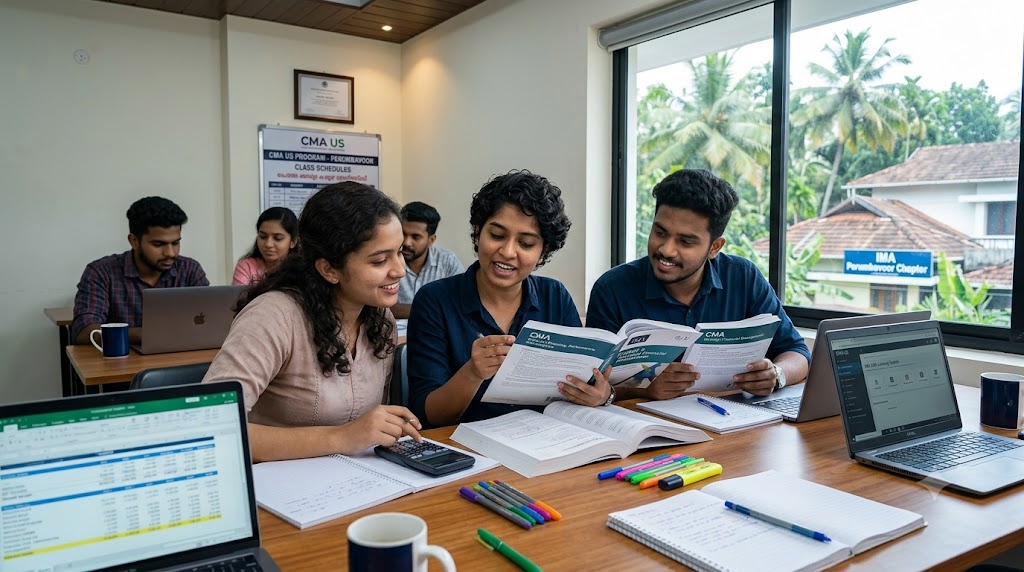
“Is CMA US actually a good option, or is it mainly for people who’ve already decided to work abroad?”
It’s a fair assumption, but not quite right. CMA US, awarded by the IMA in the United States, is genuinely useful for two different kinds of students — the ones planning to work internationally, and the ones targeting MNCs, GCCs, and shared services centres that are increasingly common within India itself. You don’t need to be leaving the country for the credential to matter.
“Why does everyone say CMA US is ‘faster’? Faster than what, exactly?”
Faster than most people expect, and faster than CMA India specifically. CMA US is just two exam parts — Financial Planning, Performance & Analytics, and Strategic Financial Management — each a single 4-hour sitting with 100 MCQs plus case-based questions. Most students complete both parts in 6 to 18 months, especially if they’re self-paced and consistent, compared to the multi-year timeline of a paper-heavy course.
“What actually gets tested — is it more accounting, or more strategy?”
More strategy than most students expect going in. Part 1 covers external reporting, budgeting, cost management, internal controls, and technology and analytics. Part 2 goes further into financial statement analysis, corporate finance, risk management, investment decisions, and professional ethics. It’s built around decision-making and planning, not compliance or audit — that’s actually the biggest mindset shift for students coming from a more traditional accounting background.
“Do I need a degree already, or can I start CMA US right after Plus Two?”
You can begin preparing and attempting the exams earlier, but full certification requires a bachelor’s degree plus two years of relevant work experience. In practice, most students either start CMA US during their final year of graduation or shortly after, so the experience requirement is being fulfilled around the same time they’re clearing the exams.
“Where do people actually end up working after CMA US?”
CMA US graduates go into roles like Management Accountant, FP&A Analyst, Financial Analyst, Cost Accountant, and eventually Financial Controller or Finance Manager. A lot of that hiring — MNCs, GCCs, Big 4 advisory, banks, tech, FMCG — happens at companies with a strong presence across Kerala’s growing finance and shared-services hubs, in addition to opportunities abroad.
“Why choose structured coaching for this instead of studying it entirely online?”
Online-only prep works for some students, but CMA US rewards structured pacing — it’s easy to under-study a self-paced course precisely because there’s no fixed classroom schedule forcing consistency. Vega Basecamp gives students that structure through in-person guidance and mock exam practice, so the course doesn’t become something you fit in “whenever.”
“Is CMA US enough on its own, or should I be pairing it with something else?”
Depends entirely on your goal. If you’re set on corporate finance and global mobility, CMA US alone is a strong, complete credential. If you’re also interested in India-specific statutory cost-audit work, that’s actually a different qualification — CMA India — and it’s worth understanding both before committing to just one.
Have a CMA US question that didn’t come up here?
Ask Vega Basecamp directly or reach us at info@vega-basecamp.org / 9633023993.